Egyptian President El-Sisi Arrives in India for 18th BRICS Summit
Published
Updated
2 min read 3 views
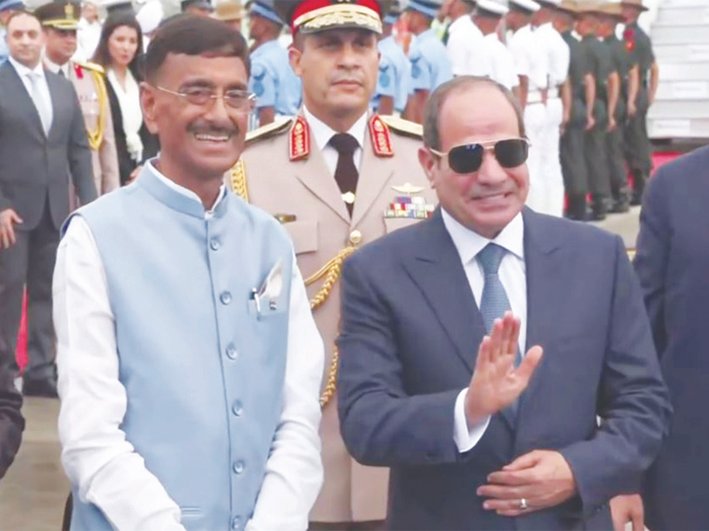
NEW DELHI, Sep 11 : Egyptian President Abdel Fattah El-Sisi arrived in New Delhi on Friday to attend the 18th BRICS Summit, which India will host on September 12-13 under its 2026 chairship.
El-Sisi was received at the airport by Minister of State for Defence Sanjay Seth, Palam Air Base Commander Brigadier General Vijay Rao, Suresh Kumar, Director of the North Africa and West Asia Division at the Ministry of External Affairs, and Indian protocol official Nisha Dhawal.
His arrival comes as several heads of state and senior dignitaries gather in the national capital for the high-level summit. Russian President Vladimir Putin and Iranian President Masoud Pezeshkian have also arrived in India, while United Nations Secretary-General Antonio Guterres is in New Delhi for the gathering.
The Egyptian Presidency said Egypt's participation marks its third consecutive BRICS summit since the country joined the bloc in January 2024.
India is hosting the 18th BRICS Summit under the theme "Building for Resilience, Innovation, Cooperation and Sustainability." Development, sustainability and innovation are among the key areas of focus during India's chairship.
BRICS has emerged as an important platform for coordination among major emerging economies and for advancing the interests of the Global South in multilateral institutions. Its agenda covers areas including development, finance, technology, trade and people-to-people exchanges.
The grouping currently comprises 11 countries — Brazil, China, Egypt, Ethiopia, India, Indonesia, Iran, Russia, Saudi Arabia, South Africa and the United Arab Emirates.
Together, BRICS members account for around 49.5 per cent of the global population, 40 per cent of global GDP and 26 per cent of global trade, according to background information on India's 2026 chairship.
India's chairship comes amid growing global economic fragmentation, technological disruption, geopolitical uncertainty, climate change and resource pressures. The expanded grouping provides a platform for cooperation in areas including development, climate action, technology, energy and financial resilience, while also contributing to discussions on reforming global institutions.