India Auto Retail Sales Surge 18% in August to Record 24.23 Lakh Units
Published
4 min read 2 views
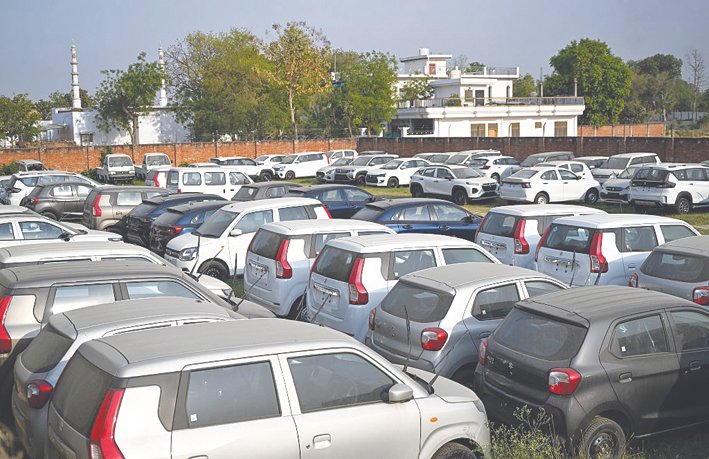
New Delhi, Sep 7 : India's automobile retail market recorded its strongest-ever August performance, with total vehicle sales rising 18 per cent year-on-year to 24.23 lakh units, according to data released by the Federation of Automobile Dealers Associations (FADA) on Monday.
The record performance came despite a 6.48 per cent month-on-month decline from July, when retail sales had touched an all-time high. Dealers attributed the sequential decline largely to the monsoon season and changes in the festive calendar, with Ganesh Chaturthi and part of the Onam-driven demand shifting to September.
Most major vehicle categories registered their best-ever August sales. Construction equipment led annual growth at 31.45 per cent, followed by two-wheelers at 19.69 per cent, passenger vehicles at 16.14 per cent and commercial vehicles at 14.45 per cent. Three-wheeler sales increased 8.64 per cent, while tractor sales remained broadly stable, rising 0.84 per cent.
Passenger vehicle retail sales reached 4,02,398 units in August, up 16.14 per cent year-on-year. It was the segment's highest-ever August performance and the first time monthly August sales crossed the four-lakh-unit mark. On a month-on-month basis, however, passenger vehicle sales declined 3.40 per cent.
Rural markets continued to outperform urban areas. Rural passenger vehicle sales jumped 24.99 per cent from a year earlier, more than twice the 10.93 per cent growth recorded in urban markets.
August also witnessed a significant shift in consumer powertrain preferences. CNG vehicles accounted for 25.28 per cent of passenger vehicle sales, followed by hybrids at 9.04 per cent and electric vehicles at 7.63 per cent. Together, these alternative-fuel categories accounted for 41.95 per cent of passenger vehicle retail sales, marginally higher than the 40.85 per cent share of petrol/ethanol vehicles.
Dealers said rising operating costs and uncertainty surrounding the transition to E20 fuel were prompting some customers to consider CNG, hybrid and electric vehicles over conventional petrol models.
Despite healthy retail demand, passenger vehicle inventory remained elevated. Stock levels increased by another five days from the end of July to around 38-40 days, significantly above FADA's preferred inventory level of 21 days. Around 56 per cent of passenger vehicle dealers reported an increase in inventory during August.
With manufacturers and dealerships preparing for the festive season, dealers have called for production and billing to be better aligned with actual retail demand to prevent capital from being locked up in ageing inventory.
Two-wheeler retail sales rose 19.69 per cent year-on-year to 17,14,610 units, making August the segment's strongest-ever performance for the month and its first new August record since 2018.
Rural two-wheeler demand again outpaced urban markets, with sales increasing 20.25 per cent in rural areas compared with 19.07 per cent in cities. Dealers attributed the growth to improved affordability following GST 2.0 and resilient rural demand.
Electric two-wheelers continued to gain ground, with their share rising to 10.68 per cent from 7.66 per cent a year earlier. August marked the first time EVs accounted for more than a tenth of two-wheeler retail sales in a non-festive month.
Commercial vehicle retail sales increased 14.45 per cent year-on-year to 90,769 units, the highest August figure on record. Sales declined 8.93 per cent from July, reflecting the seasonal slowdown in freight activity.
Rural commercial vehicle demand rose 16.33 per cent annually, outperforming the overall segment. Light commercial vehicles registered 15.32 per cent growth, while heavy commercial vehicles grew 13.98 per cent and medium commercial vehicles increased 10.38 per cent.
Dealers cited infrastructure activity, mining operations, e-commerce logistics demand and stable financing conditions as key factors supporting commercial vehicle sales.
Electric commercial vehicles also strengthened their position, with their share reaching a record 5.18 per cent in August, compared with 2.06 per cent a year earlier. The rise in e-CV volumes indicates that fleet operators are increasingly moving beyond pilot projects towards actual vehicle purchases, although the industry remains watchful of price increases expected in September.
Three-wheeler retail sales rose 8.64 per cent year-on-year to 1,22,281 units, setting a new August record. Electric models continued to dominate the segment, with EV penetration reaching 65.30 per cent, highlighting the rapid shift towards electric mobility in the three-wheeler market.
Overall, the August data points to broad-based strength in India's automobile market, with robust rural demand, improved affordability and faster adoption of alternative powertrains emerging as key trends ahead of the crucial festive sales season.