Surjewala attacks Centre over US tariff threat, warns of risks to India’s economic sovereignty
Published
Updated
5 min read 5 views
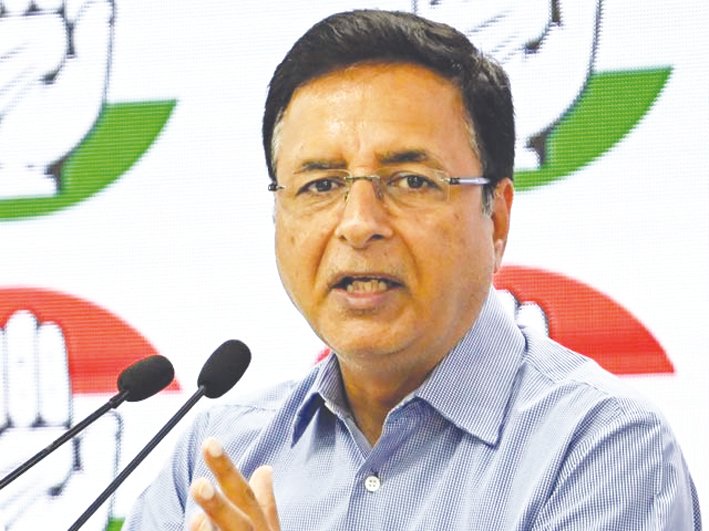
NEW DELHI, Sep 20 : Congress leader Randeep Singh Surjewala on Sunday criticised the Narendra Modi government over the United States' proposed tariffs on Indian exports, alleging that the move exposed India's economic interests to external pressure and raised questions over the country's economic sovereignty.
In a statement posted on X, Surjewala accused the government of failing to protect India's right to purchase affordable energy from countries based on its national interests. He described the situation as "100% Tariffs, 0% Spine!" and alleged that India's economic and national interests had been compromised.
"India is a sovereign republic with the right to buy energy from any Nation that meets our National Interests and at a price our people can afford," Surjewala said, adding that India's ties with Washington could not make its national interests "subservient to the demands of the White House".
At the centre of his criticism is India's continued purchase of Russian crude and the possibility of tougher US sanctions and tariff measures against countries buying Russian energy.
Surjewala claimed that Russia was India's largest crude supplier between March and June 2026, with imports totalling 244.89 million barrels. He also referred to the Lindsey O. Graham Sanctioning Russia and Iran Act of 2026, which he said was signed into law on September 18 and could provide the US President with authority to impose tariffs of up to 100 per cent on countries purchasing Russian energy.
He alleged that the government had failed to develop sufficient economic and diplomatic leverage to withstand pressure from Washington. According to Surjewala, India's export economy, which he valued at $86.5 billion in the sectors affected by the measures, could face significant disruption if additional tariffs are imposed.
Laying out what he described as a "chronology" of events, Surjewala alleged that Washington had earlier sought a reduction in India's purchases of Russian crude and that Indian imports subsequently declined before rising again as global energy-security concerns intensified.
He said Russian crude imports rebounded to 2.08 million barrels per day in March and alleged that the share rose to 56 per cent of India's imports in July before standing at 45 per cent, or 2.08 million barrels per day, in August.
Surjewala also pointed to the potential impact of higher US tariffs on Indian exporters. He cited existing Section 232 tariffs on steel, aluminium, copper and derivatives and argued that, if a full 100 per cent tariff under the Graham Act were imposed, some affected metal exports could face a combined tariff exposure of up to 150 per cent.
He warned that India's textile industry could also face significant pressure. Citing calculations in his statement, Surjewala said Indian cotton garments could face a combined tariff burden of 126.5 per cent, compared with 26.5 per cent for Bangladesh and 29 per cent for Vietnam.
According to Surjewala, such a differential could encourage US buyers to shift orders to competing countries and put pressure on Indian MSMEs operating on margins of around 5-8 per cent.
He identified Panipat's handloom industry, Tiruppur's knitwear sector, Andhra Pradesh's aquaculture industry and the diamond-cutting and polishing industry in Surat and Saurashtra among the sectors potentially vulnerable to further trade restrictions.
Surjewala claimed that Panipat's handloom industry has an annual turnover of around Rs 60,000 crore, including Rs 20,000 crore in exports, with approximately 60 per cent of those exports destined for the US. He alleged that earlier tariff measures and supply disruptions had already reduced business substantially and warned that another steep increase could lead to factory closures.
On Tiruppur, he said the knitwear cluster exports around Rs 45,000 crore annually, including approximately Rs 15,000 crore to the US. He claimed exporters had reported orders worth Rs 3,000 crore being put on hold following earlier tariff increases and warned of possible job losses, particularly among migrant workers.
Surjewala also highlighted Andhra Pradesh's aquaculture industry, claiming that the state accounts for about 82 per cent of India's shrimp production and that the US market is worth approximately $2.4 billion. He said higher US duties had already put pressure on shrimp farmers and warned that another major tariff increase could further reduce their margins.
On the diamond industry, Surjewala cited disruptions caused by sanctions affecting Russian rough diamonds and claimed that the measures had affected the availability of raw materials for India's cutting and polishing sector. He also referred to figures cited by a workers' union in Gujarat regarding deaths by suicide among diamond workers, linking them to debt and reduced working hours.
Surjewala argued that the issue extended beyond tariffs and trade to India's broader economic sovereignty.
"True sovereignty means having the strength to make independent geopolitical choices and protect the domestic economy from the consequences," he said.
The Congress leader's remarks come amid continuing uncertainty among Indian exporters over possible US sanctions and additional tariff measures. The products that could ultimately be covered, the applicable tariff rates and the manner in which any new measures are implemented will depend on subsequent decisions by the US administration.