BRICS Parliamentary Forum condemns unilateral sanctions, reaffirms support for two-state solution
Published
5 min read 2 views
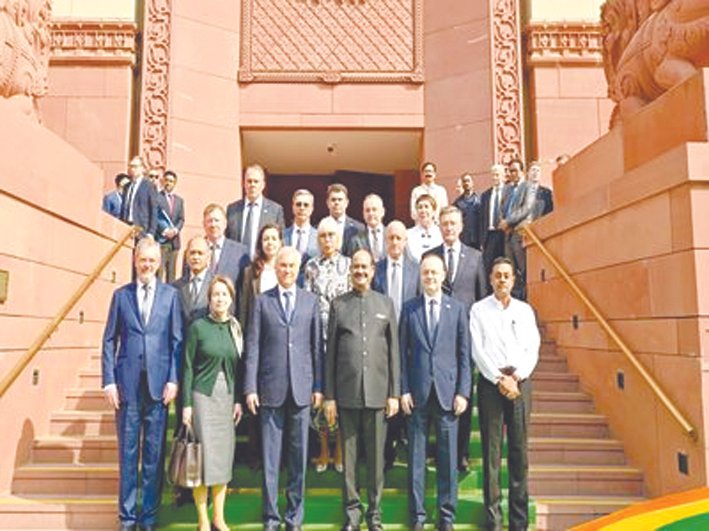
New Delhi, Oct 27 : The 12th BRICS Parliamentary Forum has condemned unilateral economic and secondary sanctions that violate international law, calling for their elimination and warning of their adverse impact on development, healthcare and food security.
The forum also expressed concern over escalating tensions in the Middle East and West Asia, urged all parties to exercise restraint and pursue diplomatic solutions, and reaffirmed its unwavering support for resolving the Israeli-Palestinian conflict through a two-state solution.
These positions were outlined in a joint declaration adopted at the conclusion of the two-day parliamentary forum in New Delhi on Tuesday.
The participating parliaments highlighted the adverse consequences of unilateral coercive measures on the right to development and access to healthcare and food security. They maintained that such measures were contrary to international law and should be eliminated.
On the Israeli-Palestinian conflict, the declaration reiterated support for a peaceful two-state solution, with Israel and Palestine living side by side in peace and security in accordance with international law and relevant United Nations resolutions. It also reaffirmed the Palestinian people's right to self-determination, freedom and an independent, sovereign state.
Expressing concern over rising tensions across the Middle East and West Asia, the parliamentary leaders called on all parties to exercise maximum restraint and refrain from actions that could further escalate the situation. They emphasised the need to protect civilians and civilian infrastructure, respect the sovereignty and territorial integrity of states, and pursue dialogue and diplomacy to achieve lasting peace.
The declaration also stressed that regional stability was essential for international trade, supply chains and energy flows.
The participating parliaments strongly condemned violations of international humanitarian law, including deliberate attacks on civilians and civilian infrastructure, obstruction of humanitarian assistance and attacks on humanitarian personnel. They called for accountability for such violations.
On terrorism, the declaration condemned the menace in all its forms and manifestations, describing it as criminal and unjustifiable. It called for stronger international cooperation to tackle cross-border movement of terrorists, terror financing and safe havens.
The forum emphasised that terrorism should not be linked to any religion, nationality, civilisation or ethnic group and called for those responsible for terrorist activities, along with their supporters, to be held accountable.
Reiterating the need for zero tolerance and an approach without double standards, the declaration recognised the primary responsibility of states in preventing and combating terrorism. It also stressed that counterterrorism measures must comply with the UN Charter and applicable international human rights, refugee and humanitarian laws.
The forum backed the work of the BRICS Counter-Terrorism Working Group and its five subgroups, called for progress towards adopting the Comprehensive Convention on International Terrorism, and urged action against terrorists and entities designated by the United Nations.
The declaration's position on West Asia comes against the backdrop of difficult negotiations within BRICS over regional conflicts. A meeting of BRICS foreign ministers in New Delhi on May 15 ended without a joint statement due to differences over West Asia, Gaza and the Red Sea, including the Bab al-Mandab Strait. India subsequently issued a chair's statement.
However, the 18th BRICS Summit, held in New Delhi on September 12 and 13 under India's 2026 chairship, unanimously adopted the New Delhi Leaders' Declaration following negotiations.
Held under the theme "Fostering Parliaments for People-Centric Development", the parliamentary forum was aligned with India's broader BRICS chairship theme, "Building for Resilience, Innovation, Cooperation and Sustainability".
The forum brought together presiding officers and parliamentary representatives from Brazil, China, Egypt, Ethiopia, India, Indonesia, Iran, Russia, South Africa and the United Arab Emirates, along with representatives of partner countries.
The joint declaration called for reforms in the United Nations, including the Security Council, to make the global organisation more representative, democratic, effective and responsive to contemporary realities. It also stressed strengthening multilateralism and ensuring a greater role for the Global South in international decision-making.
The forum underlined the importance of engagement with the Inter-Parliamentary Union and took note of Russia's proposal to establish a BRICS Plus geopolitical group within the organisation.
The participating parliaments reaffirmed their commitment to strengthening the BRICS strategic partnership in political and security cooperation, economic and financial affairs, and cultural and people-to-people exchanges. They also reiterated support for the UN 2030 Agenda for Sustainable Development and global efforts to eradicate poverty.
On climate change, the declaration called for measures relating to mitigation, adaptation, just transitions and the implementation of nationally determined contributions. It emphasised the principle of common but differentiated responsibilities and urged developed countries to provide climate finance and facilitate technology transfer.
Recognising the opportunities and challenges posed by artificial intelligence and information and communications technologies, the forum called for their safe, secure and equitable use, with due regard for digital sovereignty and data privacy.
It supported the development of parliamentary AI tools, the creation of a repository of digital public infrastructure and pilot projects aimed at promoting universal connectivity.
The declaration also highlighted the importance of cultural cooperation and people-to-people engagement, encouraging exchanges in education, art and sports, along with initiatives involving women and young people.
It marked the 10th anniversary of the BRICS Women's Parliamentarians Forum and recalled the 2016 Jaipur Declaration, which called for annual meetings of the forum.
Participants also took note of Russia's proposal to establish a BRICS inter-parliamentary working group on sports and supported parliamentary training and capacity-building initiatives.
Congratulating the Indian Parliament on hosting the forum, the declaration confirmed that the next BRICS Parliamentary Forum would be held in 2027 under China's chairship.