Gaganyaan Delay Must Be Taken With a Pinch of Salt, Mission Success More Important: Astronaut Angad Pratap
Published
Updated
3 min read 4 views
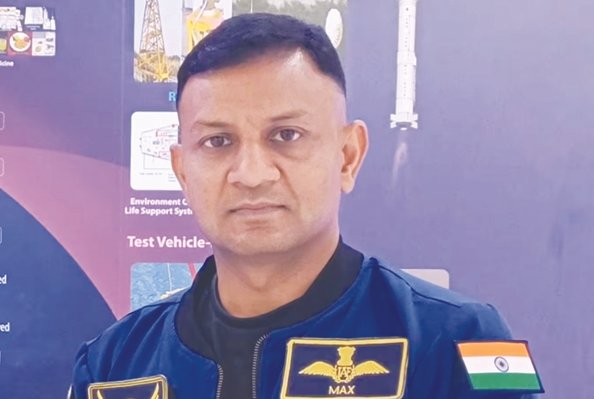
Bengaluru, Sep 9: India's maiden human spaceflight mission Gaganyaan should not be rushed merely to meet a deadline, astronaut-designate Group Captain Angad Pratap said on Wednesday, stressing that mission success was more important than adhering to its original timeline.
Speaking to reporters on the sidelines of the 9th Bengaluru Space Expo 2026, Pratap acknowledged that Gaganyaan, originally envisaged for 2024, had been delayed, but said such delays were inherent to a pioneering human-spaceflight programme.
“Gaganyaan was supposed to take place in 2024, but the time is passing. As an astronaut, you have to start living with the fact that there are going to be delays in prototype programmes,” he said.
Pratap said Gaganyaan could not be compared with established human-spaceflight programmes where astronauts join a programme with a ready spacecraft, rocket and assured launch schedule.
“We did not join as astronauts in a programme where the vehicle is ready, the rocket is ready and you come and there is a date. We joined a prototype programme, not only for the flight, but to build that programme with whatever small contribution we can make,” he said.
He said the astronauts continued to train and prepare according to the timeline prescribed by ISRO headquarters while also contributing to the programme's development on the ground.
“It is not always about the flight alone. There is a lot of work which happens on the ground. It might be delayed by a few months or one or two years. But once it happens, it has to be positively successful,” Pratap said.
Urging patience, he cautioned against rushing the programme at the cost of reliability.
“You don't want to fail at the start point itself. The programme will get, probably, it will just stop, for all we know. We don't want that to happen,” he said.
“There are a lot of brightest minds in the country who are responsible for this. Let's trust them. Let's be patient. Let it happen at its own pace,” Pratap added.
Pratap also highlighted the wider role astronauts are playing in building India's human-spaceflight capability. As an experimental test pilot, he said he was involved in the human-machine interface, operational requirements and the design process for the spacecraft's front-end architecture.
“I don't design the entire cockpit, but I am a part of the design process for the front-end architecture,” he said.
He said astronauts worked with designers by bringing their aviation and operational experience to determine how spacecraft systems should function while taking into account hardware realities.
“It is a very new concept. No one person can take claim that I have designed this,” Pratap said.
On expanding the astronaut pool, he said reports of plans to select six more test pilots and four professionals from non-aviation backgrounds reflected efforts to build a wider human-spaceflight capability.
He said expertise in one core discipline would only be the starting point, with selected candidates subsequently required to acquire knowledge of aviation, engineering and medicine.
“Being an expert in one subject will not make you an astronaut,” he said.
Pratap said an astronaut ultimately needed to be capable of flying, understanding and maintaining systems, contributing to scientific and engineering tasks, and taking care of their own health as well as that of fellow crew members.
Asked about his participation in Aero India 2027, Pratap said it was not part of his current area of training or responsibility, as he had other assignments to prioritise.