Karnataka says Adani transmission projects unrelated to Shivakumar meeting
Published
Updated
4 min read 3 views
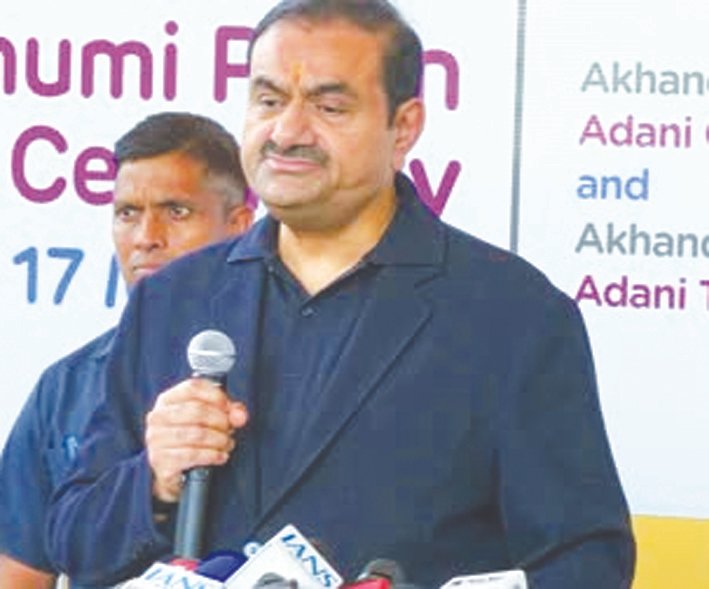
BENGALURU, Sept 8 : Karnataka on Tuesday clarified that transmission projects involving the Adani Group were not linked to the recent meeting between Adani Group Chairman Gautam Adani and Chief Minister D K Shivakumar, asserting that such projects were awarded under the Centre's transmission framework and that the State's role was limited to facilitating their execution.
Additional Chief Secretary, Energy, Gaurav Gupta, made the clarification in response to a question linking Adani's transmission investments in Karnataka with the meeting between Mr Adani and the Chief Minister.
"There is no relation at all," Mr Gupta told reporters on the sidelines of the Bharat Renewable Energy Summit and Expo 2026.
He said several private players were investing in the transmission sector and the Adani Group was only one among them. "A number of these projects are given by the Government of India through the Central Transmission Utility," he said, adding that Karnataka would extend the same facilitation to all companies implementing such projects.
The State government was coordinating with Deputy Commissioners in the concerned districts to facilitate land acquisition and right of way and prevent delays and cost or time overruns, Mr Gupta said.
"We will continue to do so, regardless of the entities, regardless of any player," he added.
The clarification comes as Karnataka seeks to accelerate investments in renewable energy and expand the transmission infrastructure required to evacuate its rapidly growing generation capacity.
Mr Gupta cited the 765-kV transmission corridor linking Vijayapura with Pune as an important project that would enable renewable power generated in Karnataka to move towards Pune and subsequently enter the national grid.
He acknowledged that land acquisition, right of way and grid connectivity could take two to three years in some cases, posing challenges to investors. The State, he said, was holding continuous discussions with industry players to identify and resolve such bottlenecks.
"Whatever are their pains, whatever is their feedback, we will definitely look at resolving their problems," he said.
Karnataka was also prepared to consider changes in laws, rules, regulations and administrative procedures wherever required to speed up investment execution, Mr Gupta said.
"We want businesses to thrive. We want the growth to happen in Karnataka, in India. We are totally committed to that," he said.
The clarification assumes significance as Karnataka prepares to host a renewable energy summit in November under the theme "Invest, Inspire and Innovate", positioning the State as a major destination for clean-energy investments.
Mr Gupta said renewable energy already accounted for more than 66 per cent of Karnataka's installed generation capacity. The State plans to add around 27 GW of generation capacity in the coming years, of which approximately 23 GW would come from renewable sources.
"Karnataka has always been a responsible player at the national level. We have always been present in solar and wind, apart from biomass and other segments," he said.
He said the growth of renewable energy was also creating opportunities in manufacturing and employment.
Mr Gupta further assured investors that the rapid expansion of renewable generation had not resulted in forced curtailment of renewable power in the State.
"Karnataka has not seen any kind of curtailment of renewable energy. I would like to assure all the renewable energy investors," he said, adding that transmission capacity would continue to be expanded in parallel with generation.
He also said Karnataka's distribution companies had remained prompt in making payments to renewable energy generators and there had been no defaults on that count.
On battery energy storage systems, Mr Gupta said storage had become increasingly important as renewable generation expanded. He noted that initiatives by the Centre, the Ministry of Power and the Ministry of New and Renewable Energy would play an important role in building storage capacity.